
Gas Nitriding Furnace: How It Works and Why It Matters
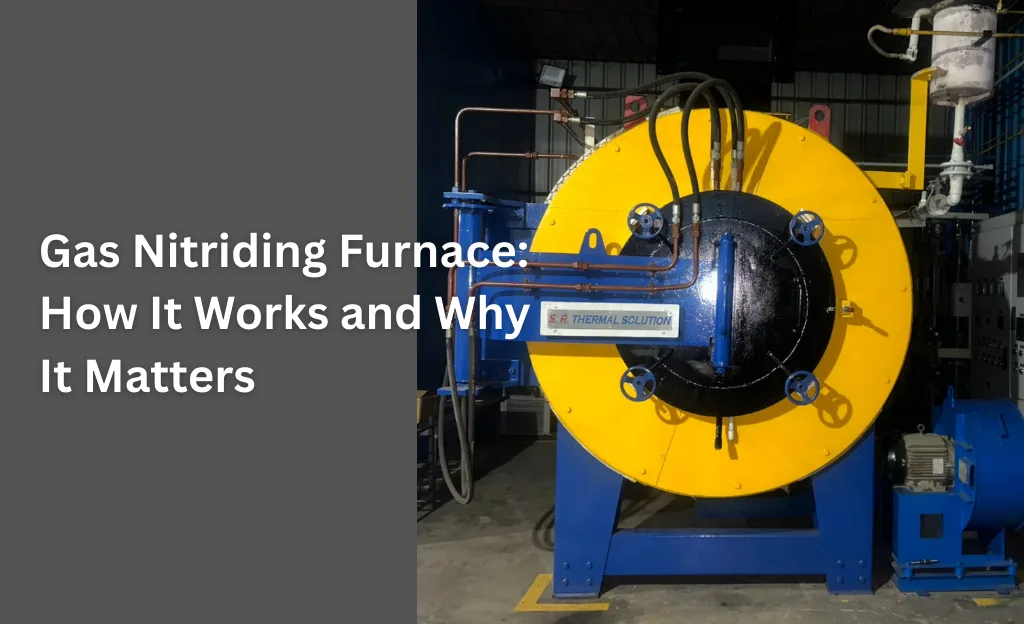
Through a regulated nitrogen diffusion process, a gas nitriding furnace is a unique heat treatment system designed to improve the fatigue strength, wear resistance, and surface hardness of steel parts. Gas nitriding furnaces are essential for extending the life and performance of industrial parts in modern manufacturing, where accuracy and strength are crucial. The need for advanced surface hardening solutions has made gas nitriding one of the most popular heat treatment techniques in a wide range of industries, from heavy engineering shafts to automotive gears.
What is Gas Nitriding?
Gas nitriding, a thermochemical surface hardening technique, involves diffusing nitrogen onto the surface of steel parts at a constant temperature, typically between 480°C and 580°C. Unlike carburizing, which uses carbon, gas nitriding uses ammonia (NH₃) gas to add nitrogen. At the surface, nitrogen reacts with alloy elements such as aluminum, molybdenum, and chromium to form hard nitrides.
The main advantage of gas nitriding is that it reduces distortion by increasing surface hardness, and it does not require rapid quenching. It is ideal for precision parts requiring dimensional stability.
How Does a Gas Nitriding Furnace Work?
To enable nitrogen diffusion into the metal surface, a gas nitriding furnace maintains a precisely regulated atmosphere and temperature cycle.
Typically, the working process includes:
Loading components: Steel components are loaded into the furnace chamber, usually on fixtures designed for continuous exposure.
Heating stage: The furnace gradually increases the temperature to reach the required nitriding range.
Ammonia introduction: When ammonia gas is introduced into the chamber, it splits into hydrogen and nitrogen.
Nitrogen diffusion: Nitrogen atoms penetrate the steel surface, creating a diffusion zone and a hard compound layer.
Cooling: Controlled cooling reduces the possibility of distortion by preventing quenching.
Modern industrial furnaces designed for nitriding use advanced temperature controllers, gas flow regulators, and programmable logic controllers (PLCs) to ensure process accuracy.
Why Gas Nitriding Furnace Matters in Industrial Applications
The value of a gas nitriding furnace lies in its ability to increase component durability and maintain dimensional accuracy. Surface quality is a non-negotiable factor in industries that rely on high-performance parts.
A key benefit of gas nitriding is that it significantly increases surface hardness, enhancing the component’s resistance to friction and heavy loads. Furthermore, the process improves wear resistance, allowing parts to perform well under sustained mechanical stress. Furthermore, gas nitriding increases fatigue strength and overall durability, extending the useful life of critical components. Improved corrosion resistance is also a major benefit, making treated parts more suitable for demanding settings. Because rapid quenching is not used in this process, distortion is reduced, improving dimensional stability and accuracy.
Gas nitriding is therefore very valuable in industries such as heavy engineering machinery, automotive manufacturing, aerospace components, and tool and die production.
Applications of Gas Nitriding in Industry
Gas nitriding is widely used in many industrial sectors where parts are subject to constant stress, friction, and heavy operational loads. It is commonly used for critical parts such as gears and crankshafts, camshafts, dies and molds, extrusion screws, and hydraulic rods. These parts often operate under high-pressure conditions and require a strong core structure with improved surface hardness.
This process is particularly useful for parts that must withstand constant friction, cyclic stress, and high-load environments without premature wear or fatigue failure. Gas nitriding helps improve performance, reliability, and extend service life in the automotive and heavy engineering industries. It is particularly useful for precision-engineered parts that require very precise dimensions because the process improves surface properties without excessive distortion.
Gas Nitriding Furnace vs Other Industrial Furnaces
Precise control of the environment is the sole purpose of a gas nitriding furnace, while many industrial furnaces are designed for processes such as carburizing, annealing, or hardening. A nitriding furnace must carefully control the chemical environment within the chamber to achieve precise nitrogen diffusion, while conventional heat treatment furnaces focus primarily on temperature control and heating cycles.
To maintain the correct nitrogen potential throughout the cycle, gas nitriding furnaces must have precise ammonia flow management. It must also have a uniform temperature distribution to ensure components have varying case depths. To ensure a consistent process, the chamber structure must be completely gas-tight to prevent atmospheric leakage. Additionally, advanced control systems with programmable settings and monitoring capabilities are essential to maintain a stable and repeatable nitriding cycle.
Due to its unique engineering that guarantees excellent surface hardness, uniform case depth and optimal nitrogen absorption, the gas nitriding furnace is far more advanced than older heat treatment systems.
Key Factors When Choosing Gas Nitriding Furnace Manufacturers
When choosing a gas nitriding furnace manufacturer, you should carefully consider their technical skills, engineering capabilities, and long-lasting support structure. Gas nitriding is a precise process, so the manufacturer should have extensive experience in designing nitriding furnaces, not just general heat treatment systems. To ensure consistent case depth and surface hardness for all parts, precise temperature control is essential. Advanced gas control and automation systems are also essential to maintain constant ammonia flow and nitrogen potential throughout the process cycle.
The quality of the refractory lining, insulation material, and chamber construction also have a significant impact on the furnace’s longevity and energy consumption. Using cheap materials can result in heat loss, poor performance, and increased maintenance costs.
Reliable after-sales service and easy access to spare parts are equally important, as ongoing support minimizes downtime and maximizes productivity. Reliable manufacturers not only provide technically sound equipment but also offer customization options based on plant capacity, production volume, and operational needs. This ensures the furnace fits seamlessly into the existing manufacturing setup.
FAQs:
Q1. What temperature is used in a Gas Nitriding Furnace?
Ans:- Typically between 480°C and 580°C, depending on the material and required case depth.
Q2. Does gas nitriding require quenching?
Ans:- No. One of the major advantages of Gas Nitriding is that it does not require rapid quenching, which minimizes distortion.
Q3.How long does gas nitriding take?
Ans:- The process duration can range from 10 to 90 hours, depending on the desired case depth and material composition.
Q4. What materials are suitable for gas nitriding?
Ans:- Alloy steels containing chromium, molybdenum, and aluminum respond best to gas nitriding.
Why Quality Matters in Gas Nitriding Furnace Manufacturing
If the furnace is not well-built, it can lead to uneven case depths, temperature variations, and inconsistent metallurgical results. Therefore, it’s important to choose a gas nitriding furnace manufacturer with extensive experience.
Whether businesses are looking for gas nitriding in Delhi, Mumbai, or Gujarat, they should focus on process expertise, precision engineering, and long-term support.
An efficient gas nitriding furnace not only ensures that the furnace continues to perform at its best, but also reduces maintenance costs and energy consumption.
Choosing the Right Industrial Partner
When considering industrial furnace factories, companies should prioritize long-term value over initial cost. Advanced gas nitriding systems offer a better return on investment (ROI) because:
- Less rework and fewer rejections
- Products have a longer life
- Less energy consumption
- Reliable production cycles
S.R. Thermal Solution is a leading gas nitriding furnace manufacturer in India, a renowned name in heat treatment technology. The company specializes in designing and manufacturing advanced industrial furnaces. The company also offers custom gas nitriding solutions designed for accuracy, durability, and operational efficiency.
S.R. Thermal Solution combines modern furnace engineering with metallurgical expertise to deliver consistent performance and reliable after-sales support, making it a great choice for businesses across India.
Conclusion
A gas nitriding furnace is more than just a heat treatment system; it’s an essential investment in product durability, performance, and manufacturing efficiency. By enabling controlled nitrogen diffusion without distortion, gas nitriding increases wear resistance and fatigue life in high-performance components. As industries increasingly demand robust and long-lasting parts, the role of advanced gas nitriding furnace manufacturers is becoming increasingly important. Choosing the right partner not only ensures technical accuracy but also sustainable industrial growth.
If you are looking to improve your heat treating capabilities, partnering with an experienced manufacturer like S.R. Thermal Solution can help you achieve consistent results, operational efficiency, and long-term reliability in gas nitriding applications.