



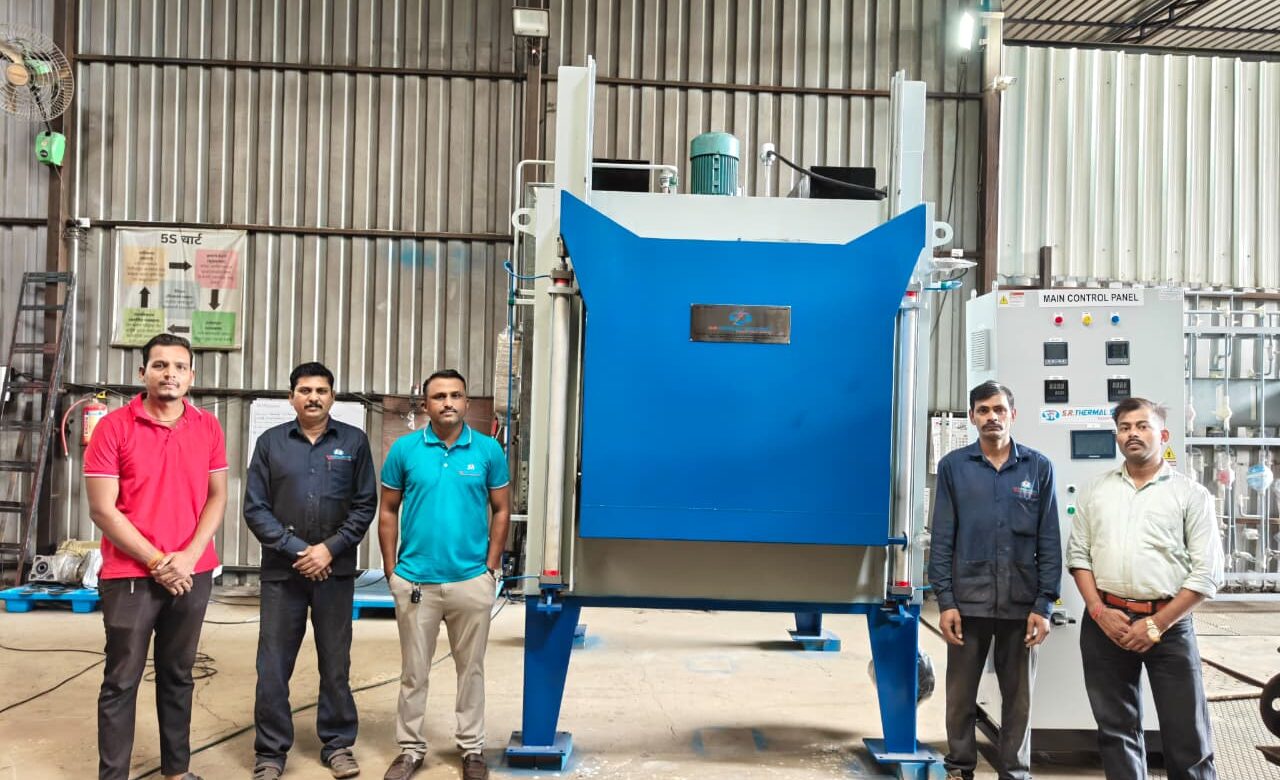
Pit Type Tempering Furnace Manufacturer in India | SR Thermal Solution
Pit Type Tempering Furnace Manufacturer in India — SR Thermal Solution, Pune
SR Thermal Solution is a trusted pit type tempering furnace manufacturer in India, designing and building custom vertical pit furnaces from our ISO-certified manufacturing facility in Chikhali, Pune. Our pit type furnaces are engineered for tempering, hardening, carburizing, nitriding, stress relieving, and aging of long, heavy, and shaft-type components that cannot be processed in conventional box furnaces.
A pit type tempering furnace is installed below floor level, with vertical loading from the top using an overhead crane. This unique design accommodates components up to 3 metres long and batch weights up to 5,000 kg — making it the furnace of choice for manufacturers processing crankshafts, camshafts, long shafts, cylinder liners, gun barrels, heavy forgings, and large dies.
Whether you need a small 300 kg vertical pit furnace for your tool room or a heavy-duty 5,000 kg pit type heat treatment furnace for your forge shop — SR Thermal Solution engineers every unit to your exact specifications with AMS 2750 temperature uniformity compliance available.
Need a quote? Contact SR Thermal Solution or call +91 8378848736. We respond within 4 hours.
What Is a Pit Type Tempering Furnace?
A pit type tempering furnace is a vertical shaft furnace installed partially or completely below floor level. Components are loaded from the top — vertically — using an overhead crane, jib crane, or hoist. The cylindrical or rectangular heating chamber extends downward into a concrete-lined pit, with the top covered by a swing-type or lift-up insulated cover.
This below-ground design offers several advantages over horizontal box type furnaces:
- Uses minimal floor space since most of the furnace is underground
- Accommodates very long components up to 3 metres or more that physically cannot fit inside a box furnace
- Gravity assists uniform temperature distribution because hot air naturally rises and circulates around vertically suspended components
- Loading and unloading is easier for heavy parts using overhead cranes — no need to push heavy loads through a front door
- Vertical orientation prevents distortion of long shaft-type components during heat treatment
Pit type tempering furnaces typically operate between 150°C and 700°C for tempering and stress relieving. Higher temperature versions up to 1050°C are available for hardening, carburizing, and nitriding processes. They can be electrically heated (most common in India) or gas/oil fired depending on the application and client preference.
Also referred to as vertical tempering furnace or pit type heat treatment furnace, this furnace type is standard equipment in forge shops, automotive crankshaft plants, defence ordnance factories, and heavy engineering facilities across India.
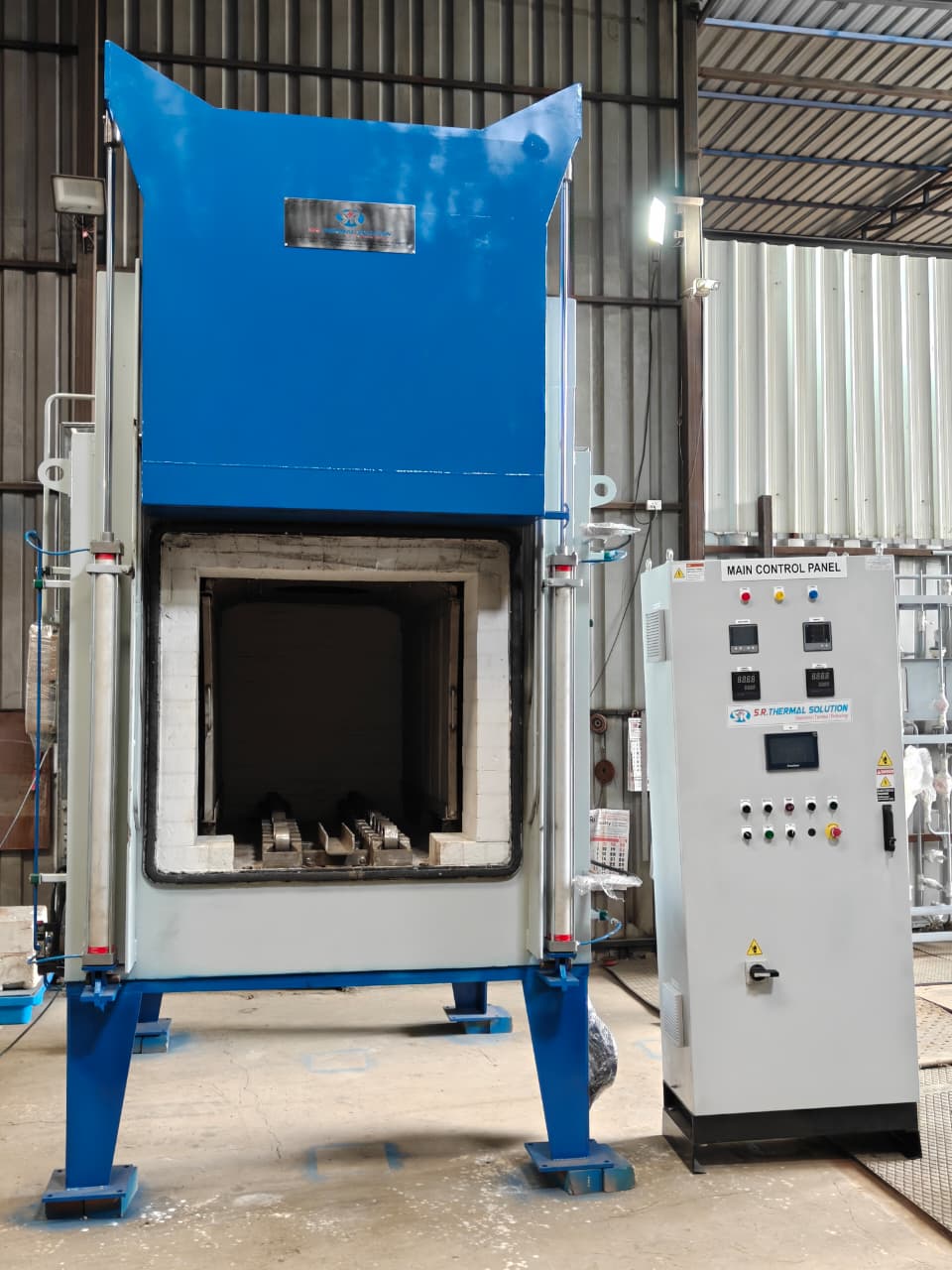
How Does a Pit Type Tempering Furnace Work?
Working Principle
The pit type furnace chamber is a vertical cylinder or rectangle lined with ceramic fibre insulation and backed by insulating brick. Electric heating elements are mounted on the inner walls in multiple independent zones — typically 2 to 4 zones — to ensure uniform temperature from top to bottom of the working zone.
Components are hung vertically on fixtures, jigs, or placed in alloy steel baskets and lowered into the chamber with an overhead crane. The insulated cover is closed, sealing the chamber.
The PID controller raises the temperature to the set point at a controlled heating rate — typically 5–10°C per minute for standard components. Once the target temperature is reached, the charge is soaked for the required duration based on component thickness. The standard soaking formula is 1.5–2.0 minutes per mm of thickness for carbon steel and 2.0–2.5 minutes per mm for alloy steel.
A forced convection fan mounted on the cover circulates the furnace atmosphere — pushing hot air downward along the walls and drawing it upward through the center of the charge. This recirculation pattern is critical for achieving plus or minus 5°C temperature uniformity across the entire working zone — from the top to the bottom of a 3 metre deep chamber.
After soaking is complete, the cover is lifted, and the charge is raised out of the furnace using the crane. Components are then placed on a cooling rack for air cooling, transferred to an oil quench tank, or moved to the next processing step.
Key Components of a Pit Type Furnace
Outer Shell: Cylindrical or rectangular mild steel fabrication with ribbed stiffeners for structural rigidity. Installed inside a concrete-lined pit with provision for drainage to handle any moisture or condensation.
Insulation: Multi-layer system using high-density ceramic fibre blanket (128 kg/m3) as primary insulation, backed by insulating brick or calcium silicate board. Total insulation thickness typically 200–300 mm depending on temperature rating. This keeps the outer shell temperature well below 60°C at maximum operating temperature.
Heating Elements: Kanthal A1 resistance wire or strip wound on ceramic formers and mounted on the furnace walls. Divided into 2–4 independent heating zones, each with its own thermocouple and power control. This multi-zone design allows compensation for natural temperature gradients in a vertical furnace — the bottom zone typically needs more power than the top zone.
Retort (optional): For controlled atmosphere applications such as gas nitriding, carburizing, or carbonitriding, a sealed retort made of AISI 310 or 304 stainless steel is placed inside the furnace chamber. The process atmosphere gas (ammonia for nitriding, endothermic gas for carburizing) is introduced inside the retort while heating elements remain outside. The retort can be sand-sealed or vacuum-sealed depending on atmosphere purity requirements.
Cover: Swing-type or hydraulic lift-up insulated top cover. Sealed with ceramic fibre gasket or silicone rubber seal for gas-tight operation. The cover houses the forced convection fan motor, thermocouple penetrations, and atmosphere gas inlet (if retort is used). Cover weight is counterbalanced for easy manual operation, or hydraulically operated for large furnaces.
Fan System: Forced air circulation fan with alloy steel impeller mounted on the cover. The fan blade pushes hot air downward along the furnace walls and draws it upward through the center of the charge — creating a controlled recirculation pattern. Fan motor is mounted externally on the cover with a water-cooled or air-cooled shaft seal to prevent bearing damage from furnace heat.
Control System: Digital PID temperature controller with multi-zone thermocouple input (Type K for up to 1100°C, Type N for higher accuracy). Thyristor or SCR power control for each heating zone — providing stepless, precise power regulation. Optional PLC-based control with SCADA interface, recipe storage, barcode traceability, and data logging for automotive OEM compliance (IATF 16949, CQI-9).
Safety Features: Over-temperature alarm and automatic cutoff. Thermocouple burnout detection and alarm. Cover interlock switch preventing heating when cover is open. Earth leakage circuit breaker. Emergency stop button. Optional water flow monitor for water-cooled components.
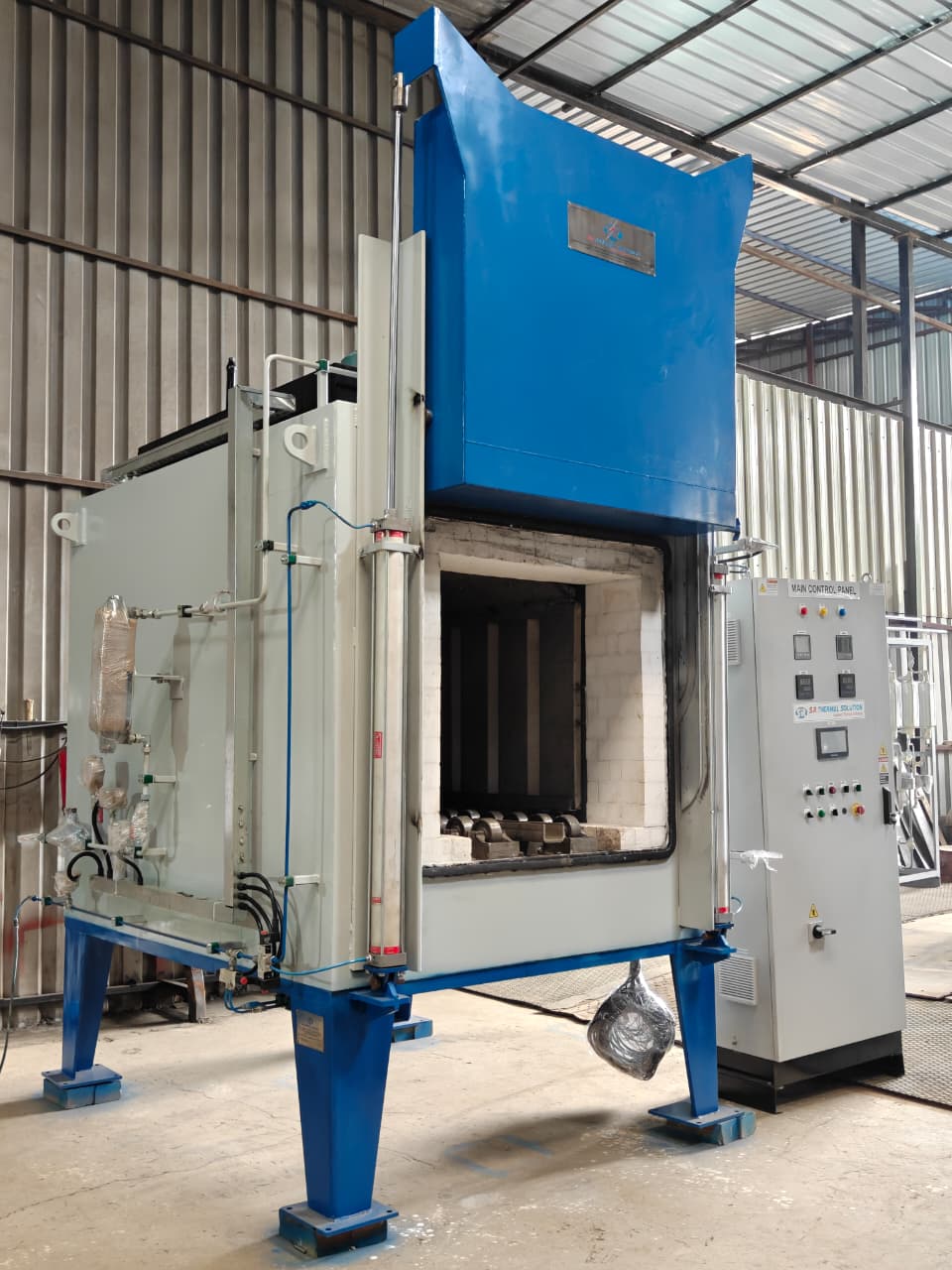
Pit Type Tempering Furnace Specifications
| Parameter | Range Available |
|---|---|
| Temperature Range | 150°C to 700°C (tempering) / up to 1050°C (hardening/nitriding) |
| Temperature Control Accuracy | Plus or minus 1°C (PID controller with thyristor, multi-zone) |
| Temperature Uniformity | Plus or minus 5°C with forced air circulation (AMS 2750 Class 3–5) |
| Heating Zones | 2 to 4 independent zones with individual thermocouples |
| Heating Source | Electric (standard) / Gas fired / Oil fired (optional) |
| Heating Elements | Kanthal A1 wire/strip on ceramic formers |
| Insulation | Multi-layer ceramic fibre blanket (128 kg/m3) plus insulating brick |
| Working Zone Diameter | 300 mm to 1500 mm (custom) |
| Working Zone Depth | 500 mm to 3000 mm (custom) |
| Load Capacity | 100 kg to 5,000 kg per batch |
| Cover Type | Swing-type manual / hydraulic lift-up |
| Circulation Fan | Forced convection with alloy steel impeller, water-cooled shaft seal |
| Retort | Optional AISI 310/304 stainless steel for controlled atmosphere |
| Atmosphere | Air / nitrogen / ammonia / endothermic gas |
| Power Supply | 415V plus or minus 10%, 3-phase, 50 Hz |
| Safety | Over-temp alarm, thermocouple burnout, cover interlock, ELCB |
| Data Recording | Optional chart recorder or paperless data logger (21 CFR Part 11 capable) |
| Compliance | ISO 9001:2015 manufacturing, AMS 2750 temperature uniformity capable |
Applications of Pit Type Tempering Furnace
Pit Furnace for Crankshaft and Automotive Components
Tempering of crankshafts is the most common application for pit type tempering furnaces in India. Crankshafts are too long for most box furnaces and must be hung vertically to prevent distortion during heat treatment.
Automotive components we regularly build pit furnaces for:
- Crankshafts and camshafts (typically 500–1500 mm long)
- Transmission shafts, propeller shafts, and steering columns
- Half shafts, axle shafts, and CV joint shafts
- Long gear shafts and splined shafts
- Coil springs and valve springs (in baskets)
SR Thermal Solution supplies pit furnaces for crankshaft tempering to automotive manufacturers and forge shops across Pune, Jamshedpur, Chennai, Gurugram, and Kolhapur.
Pit Furnace for Forging Industry
- Large forged shafts and connecting rods (2,000–5,000 kg batches)
- Hammer heads, crane hooks, and heavy lifting components
- Stress relieving of rough-machined forgings
- Normalizing of large forgings before final machining
- Die preheating for forging operations
Pit furnaces are the only practical option for forge shops handling components above 500 kg individual weight or batches above 2,000 kg.
Pit Furnace for Oil and Gas Industry
- Drill collars and well casing pipes (up to 3 metres long)
- Sucker rods and pump shafts
- Valve stems and gate valve bodies
- Pipeline fittings, flanges, and coupling components
- Stress relieving of welded pipeline assemblies
These are typically long cylindrical components that require vertical processing and precise temperature uniformity for consistent mechanical properties along the entire length.
Pit Furnace for Defence and Ordnance
- Gun barrels and artillery tubes (1.5–3 metres long)
- Mortar tubes and recoil mechanisms
- Barrel assemblies — stress relieving after final machining
- Armour plate tempering
These components demand extremely precise temperature uniformity. SR Thermal pit furnaces achieve plus or minus 5°C uniformity across 3 metre working zones — meeting defence quality requirements.
Pit Furnace for Heavy Engineering
- Hydraulic cylinder rods (often 1.5–3 metres long)
- Large machine tool spindles and ball screws
- Turbine shafts and generator rotors
- Mining equipment shafts and heavy-duty rollers
- Railway axles, coupling bars, and fish plates
Pit Furnace for Bearing Industry
- Large bearing rings and outer races (loaded in alloy steel baskets)
- Roller pins and needle rollers
- Controlled atmosphere tempering with nitrogen for bright, oxide-free finish
- Consistent temperature uniformity critical for bearing dimensional accuracy
Pit Type Furnace Installation — Civil Work & Setup
What Civil Work Is Required?
Unlike box type furnaces that simply sit on the factory floor, a pit type furnace requires a concrete-lined pit. Here is what you need to prepare:
Pit Dimensions: The pit depth equals the furnace working zone depth plus approximately 300–400 mm clearance at the bottom for wiring and drainage. The pit diameter or width is approximately 200–300 mm larger than the furnace outer shell.
Concrete Lining: The pit walls and floor must be constructed from reinforced concrete with smooth internal surfaces. Minimum wall thickness of 200 mm with waterproofing treatment.
Drainage: A drainage channel or sump with pump must be provided at the pit bottom. This handles any moisture ingress or condensation during furnace operation.
Foundation: The pit floor must be level and capable of supporting the combined weight of the furnace, charge, and fixtures — typically 2–10 tonnes depending on furnace size.
Overhead Crane: A jib crane or overhead EOT crane with sufficient capacity to lift the heaviest charge basket must be available above the pit opening. Crane hook height must allow full extraction of charge from the pit.
Electrical Supply: Three-phase power supply (415V, 50 Hz) must be brought to the pit location with appropriate circuit protection. Cable routing from the furnace (inside the pit) to the control panel (at floor level) must be planned.
SR Thermal Provides Complete Support
SR Thermal Solution provides detailed pit dimension drawings, foundation specifications, and electrical requirements before manufacturing begins. Our installation team handles furnace placement, electrical connections, thermocouple installation, control panel setup, and full commissioning on site. We also train your operators on furnace operation, maintenance procedures, and safety protocols.
Energy Efficiency Features
SR Thermal pit type furnaces are designed for energy-efficient operation:
- Multi-layer ceramic fibre insulation with low thermal conductivity reduces heat loss by up to 40% compared to traditional brick-lined furnaces
- Thyristor/SCR power control provides stepless, proportional heating — no energy wasted on contactor cycling
- Multi-zone heating allows independent power control per zone — lower zones compensate for heat loss while upper zones reduce power as heat rises naturally
- Forced convection fan improves heat transfer to the charge, reducing cycle time and energy consumption per kg
- Tight door/cover sealing with ceramic fibre gasket prevents heat escape
- Insulated cover prevents radiation loss from the top opening
Typical energy consumption for a medium-sized pit type tempering furnace (800 mm x 1500 mm, 1,000 kg load) is approximately 25–40 kWh per cycle depending on temperature and soak time.
Pit Type Furnace vs Box Type Furnace — Which Should You Choose?
| Parameter | Pit Type Furnace | Box Type Furnace |
|---|---|---|
| Loading direction | Vertical from top with crane | Horizontal from front door |
| Installation | Below floor level, requires concrete pit | Floor-standing, no civil work |
| Best for | Long shafts, cylinders, heavy forgings | General components, dies, moulds |
| Max component length | Up to 3 metres | Typically up to 1.5 metres |
| Load capacity | Up to 5,000 kg per batch | Up to 2,000 kg per batch |
| Floor space needed | Minimal — furnace is underground | Moderate floor area required |
| Temperature uniformity | Excellent with forced air fan | Good with optional fan |
| Loading ease | Requires overhead crane | Manual or forklift loading |
| Typical users | Forge shops, crankshaft plants, defence, oil & gas | Tool rooms, job shops, SMEs |
| Civil work required | Yes — concrete pit with drainage | No |
| Cost | Higher (includes civil work for pit) | Lower |
Our recommendation: If you process long shafts, crankshafts, forgings, or any components longer than 1 metre — a pit type furnace is the only practical option. For general-purpose tempering of smaller components and dies, a box type tempering furnace is more cost-effective and versatile. Many production facilities have both types for different product lines.
Pit Type Furnace Price in India
Pit type furnace prices in India depend on working zone dimensions, maximum temperature, number of heating zones, retort requirement, control system, and compliance level.
| Model | Working Zone | Load Capacity | Approx. Price |
|---|---|---|---|
| Small pit furnace | 400 mm dia x 600 mm deep | 100–300 kg | 5–10 lakhs |
| Medium pit furnace | 600 mm dia x 1000 mm deep | 300–800 kg | 10–18 lakhs |
| Large pit furnace | 800 mm dia x 1500 mm deep | 800–2,000 kg | 18–30 lakhs |
| Heavy-duty pit furnace | 1000 mm dia x 2000 mm deep | 2,000–3,500 kg | 28–40 lakhs |
| Extra-large pit furnace | 1200 mm+ dia x 3000 mm deep | 3,500–5,000 kg | 35–55 lakhs |
| Pit furnace with sealed retort | Custom with AISI 310 retort | Custom | Add 30–50% to base price |
Prices are indicative and exclude civil work (concrete pit construction, which typically costs 2–5 lakhs additional depending on depth and soil conditions). Contact SR Thermal Solution for a detailed quotation based on your specific requirements: +91 8378848736 or srthermal.solution@gmail.com.
Why Choose SR Thermal Solution for Pit Type Furnaces
We manufacture and operate heat treatment furnaces — including pit type nitriding furnaces at our own gas nitriding job work facility in Pune. This hands-on operating experience means our pit furnaces are designed for real production environments, not just specifications on paper.
We understand the real-world challenges of pit furnace operation — cover sealing issues, bottom-zone cold spots, fan motor bearing failures, retort leaks, thermocouple drift — because we deal with these daily on our own furnaces. This operational insight goes directly into every furnace we design and build.
19+ years of furnace engineering experience under Mr. Rambhau Tarase. ISO 9001:2015 and ZED certified manufacturing. 100% in-house design, fabrication, assembly, wiring, and testing at our Chikhali, Pune facility. Complete end-to-end service from consultation and design through manufacturing, factory testing, delivery, on-site installation, commissioning, operator training, and after-sales support including annual maintenance contracts.
We also manufacture gas nitriding furnaces, box type tempering furnaces, carburizing furnaces, annealing furnaces, and provide heat treatment services across India.
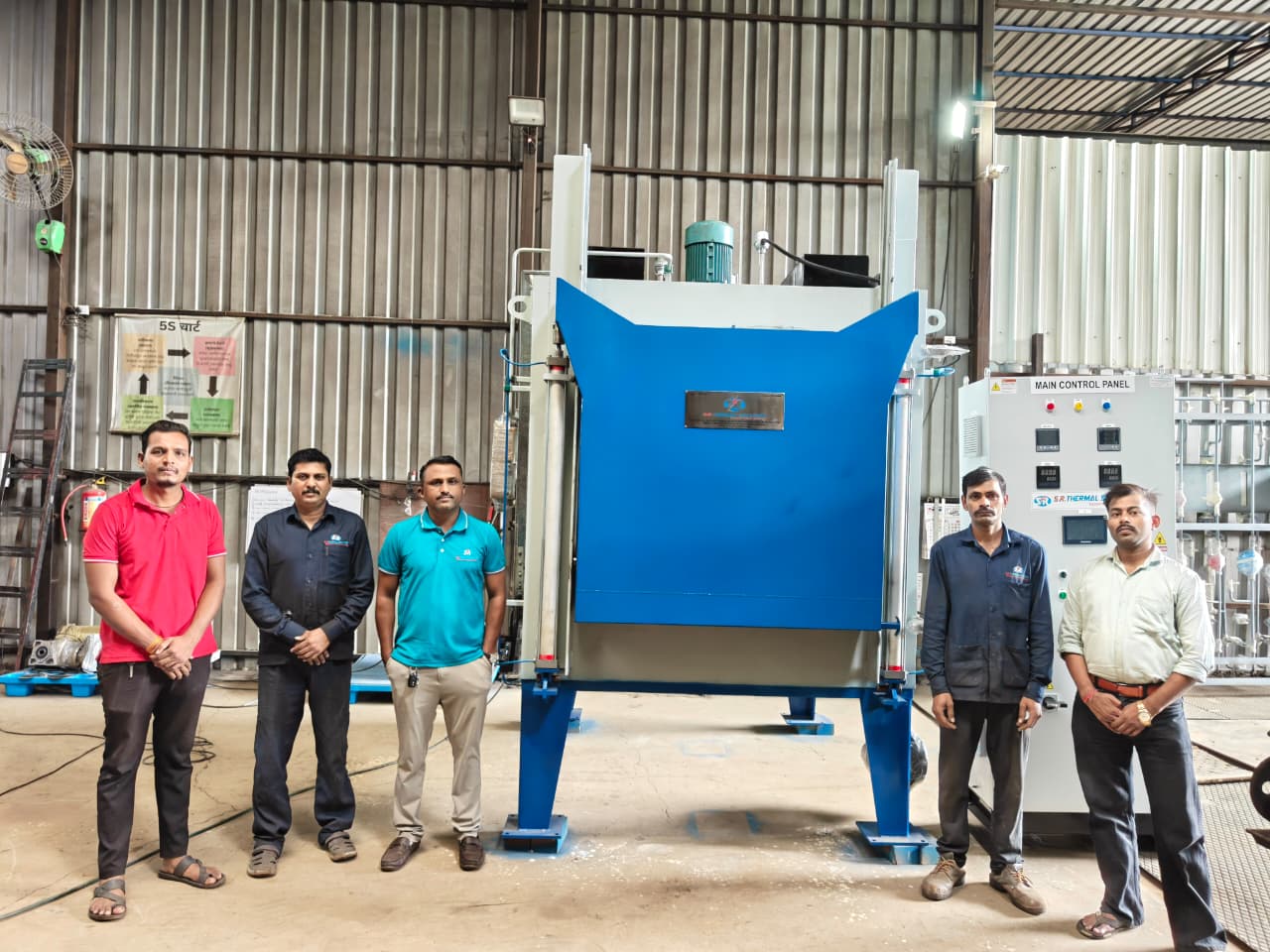
Frequently Asked Questions — Pit Type Tempering Furnace
Q1: What is a pit type tempering furnace?
A pit type tempering furnace is a vertical shaft furnace installed below floor level. Components are loaded from the top using an overhead crane. It operates between 150°C and 700°C for tempering and stress relieving applications. It is specifically designed for long, heavy, or shaft-type components such as crankshafts, camshafts, gun barrels, and large forgings that cannot fit in conventional box furnaces.
Q2: Who is the best pit type tempering furnace manufacturer in India?
SR Thermal Solution is one of India’s leading pit type tempering furnace manufacturers, based in Pune, Maharashtra. We custom-engineer pit furnaces with working zone depths up to 3 metres and load capacities up to 5,000 kg. We are ISO 9001:2015 and ZED certified with 19+ years of furnace engineering experience. Our unique advantage is that we also operate heat treatment furnaces — giving us real-world design insight.
Q3: What is the price of a pit type furnace in India?
Pit type furnace prices range from approximately 5 lakhs for a small 300 kg unit to 55 lakhs for extra-large 5,000 kg heavy-duty models. Prices exclude civil work for the concrete pit (typically 2–5 lakhs additional). The exact price depends on working zone dimensions, temperature range, number of heating zones, retort requirement, and control system complexity. Contact SR Thermal Solution for a quotation.
Q4: What components are best suited for pit type furnaces?
Crankshafts, camshafts, long shafts, propeller shafts, cylinder liners, hydraulic cylinder rods, gun barrels, drill collars, turbine shafts, large forged components, heavy bearing rings, mining equipment shafts, and railway axles. Any component that is long (over 1 metre), heavy (over 500 kg), or requires vertical orientation during heat treatment is ideal for a pit furnace.
Q5: What is the difference between a pit type and box type furnace?
Pit type furnaces load vertically from the top and are installed underground — ideal for long shafts up to 3 metres and loads up to 5,000 kg. Box type furnaces load horizontally through a front door and sit on the floor — ideal for general components, dies, and moulds up to 2,000 kg. Pit furnaces require civil work (concrete pit construction) while box furnaces need no civil work.
Q6: Does a pit type furnace need civil work?
Yes. A reinforced concrete-lined pit with proper waterproofing and drainage must be constructed before furnace installation. SR Thermal Solution provides detailed pit dimension drawings, foundation specifications, and electrical requirements for your civil contractor. The pit depth equals the furnace working zone depth plus approximately 300–400 mm clearance.
Q7: Can a pit type furnace be used for gas nitriding?
Yes. With the addition of a sealed stainless steel retort (AISI 310) and ammonia gas supply system, a pit type furnace becomes a gas nitriding furnace. SR Thermal Solution manufactures both standard pit type tempering furnaces and pit type gas nitriding furnaces from the same design platform. We also provide gas nitriding job work from our own pit type nitriding furnaces in Pune.
Q8: What temperature uniformity can be achieved in a pit type furnace?
With forced air circulation fan, SR Thermal pit type furnaces achieve plus or minus 5°C temperature uniformity across the entire working zone (AMS 2750 Class 3–5). For tighter compliance requirements, we offer plus or minus 3°C uniformity with multi-zone heating, additional monitoring thermocouples, and instrumentation designed for AMS 2750 Class 2.
Q9: Can a pit type furnace be gas fired instead of electric?
Yes. SR Thermal Solution manufactures both electrically heated and gas/oil fired pit type furnaces. Electric heating is most common in India due to precise temperature control and cleaner operation. Gas or oil fired options are available for clients who require higher heating capacity or prefer fuel-based heating for cost reasons.
Q10: Does SR Thermal provide installation and after-sales support?
Yes. Full end-to-end support — consultation, custom design, manufacturing, factory testing, delivery, on-site installation with electrical and piping connections, commissioning, temperature uniformity survey, operator training, and after-sales service including AMC contracts, spare parts supply, and remote troubleshooting. We support clients across India and internationally.
Q11: What compliance standards can SR Thermal pit furnaces meet?
Our pit type furnaces can be designed to comply with AMS 2750 (temperature uniformity and instrumentation), CQI-9 (automotive heat treatment system assessment), and IATF 16949 (automotive quality management). We provide full documentation including temperature uniformity survey reports, system accuracy test certificates, and calibration records.
Q12: Where is SR Thermal Solution located?
SR Thermal Solution is at Gat No-1544, Sonawane Wasti Road, Near Vikas Anath Ashram, Chikhali, Pune – 411062, Maharashtra, India. We are in the PCMC (Pimpri Chinchwad) industrial area, 15 minutes from Bhosari MIDC, 25 minutes from Chakan, and accessible from Mumbai-Pune Expressway and Pune-Nashik Highway.
Order Your Pit Type Tempering Furnace — Contact SR Thermal Solution
SR Thermal Solution is your trusted pit type tempering furnace manufacturer in India. From small 300 kg vertical furnaces to heavy-duty 5,000 kg production units — we design, manufacture, install, and commission.
Phone: +91 8378848736 / +91 8975966868
Email: srthermal.solution@gmail.com / srtssales@gmail.com
WhatsApp: +91 8378848736
Address: Gat No-1544, Sonawane Wasti Road, Near Vikas Anath Ashram, Chikhali, Pune – 411062, Maharashtra, India
Working Hours: Monday–Saturday, 9:00 AM – 7:00 PM